
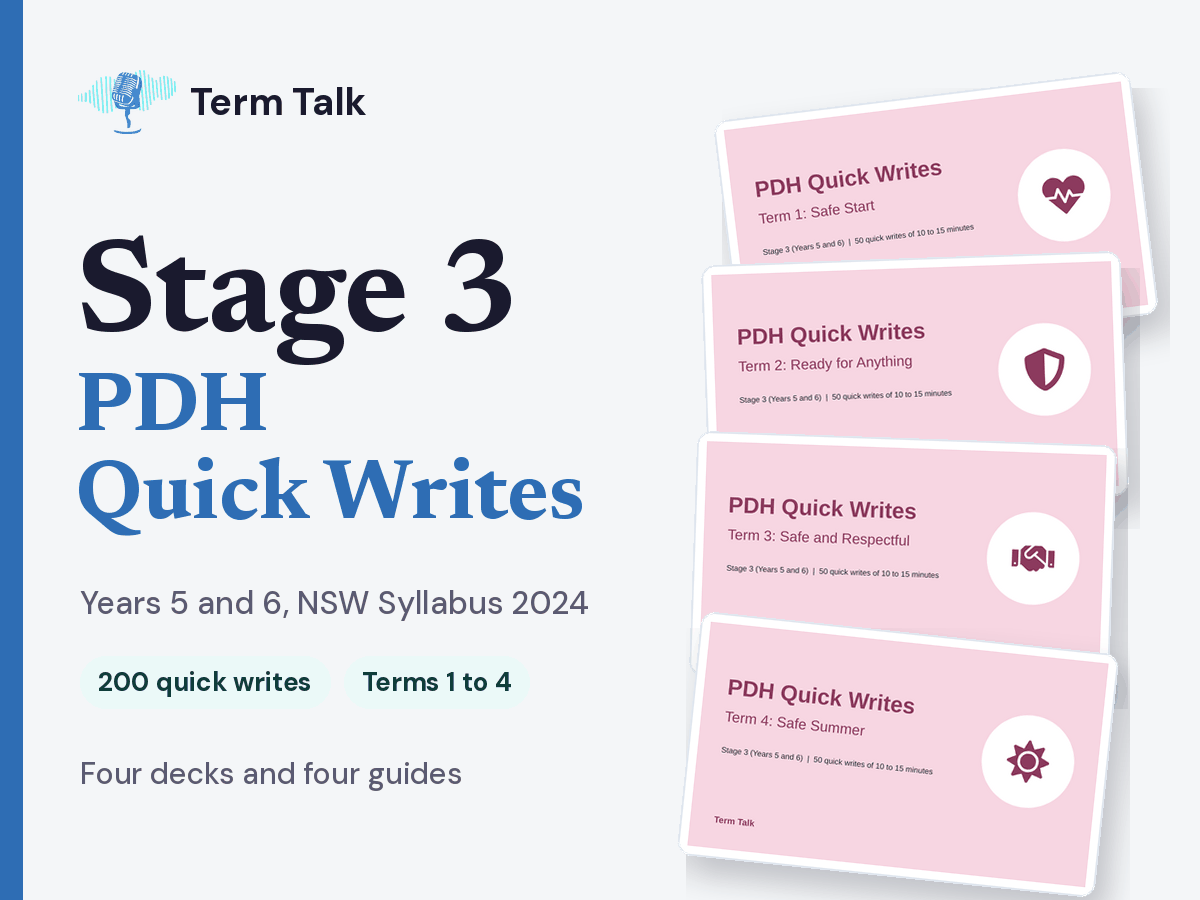
PDH Quick Writes, Full Year, Stage 3 (Years 5 and 6)
No-prep daily writing for health and safety across the whole school year, linked to the new NSW PDHPE syllabus. 200 quick writes, ready for a casual or relief day.
$15.00 AUD
$20 as 4 term packs.
Term Talk members pay $3.00
Buy this resource Join the membership and save 80%Buying first? Join within 60 days and I will credit what you spent against your first membership payment.
Instant download, emailed to you. Single classroom licence. Licence terms and refund policy.
What you get
- All four terms for Stage 3 (Years 5 and 6), each building on the last
- 200 quick writes, 50 a term, each with a teacher example
- Four PowerPoint decks of 107 slides and four PDF teacher guides
- A health and safety topic each week: small, everyday and calm, with no scary content
- The same routine every Monday and every Friday, all year
- Three challenge levels on every prompt, so every student can start and every student can stretch
- Written for the new NSW PDHPE K to 6 Syllabus (2024), taught from 2027, supporting PH3-CWT-01, PH3-IHW-01, PH3-RRS-02 and PH3-SMI-01, and it works in any Australian state
- Linked to the NSW English K to 10 Syllabus (2022), creating written texts: EN3-CWT-01
- Ready for a casual or relief day: your instructions are in the slide notes, so students only see the prompts and examples
About this resource
One year, planned as one
200 short writing warm-ups, designed as one school year. Every week keeps the same shape and each term builds on the last, so skills grow without the routine changing.
Perfect for you if…
- You want the whole year planned, each term building on the last
- You want a daily writing warm-up with no preparation, every term, that a casual or relief teacher can run from the slide notes
- Every scene is small, everyday and calm: students practise safe choices, giving reasons and asking for help
The same routine every day
- Look (1 minute): read the prompt together
- Think and talk (1 minute): partners share one idea
- Write (6 minutes, or up to 11 if they are still going)
- Share (2 minutes): a few volunteers read aloud, then show the teacher example
Students learn the routine once, so their energy goes into the writing.
Three challenges on every prompt
- One dot is a starting point
- Two dots asks for more
- Three dots asks for deeper thinking, not longer writing
Students choose their level and you guide them, so a mixed class starts together and stretches from there.
Peek inside Read two short passages from the slides
Week 1 Monday prompt, in each term
Term 1: It is 3 pm and the crossing outside school is busy. Describe the safe choices you notice, then decide which one matters most.
Term 2: The evacuation alarm rings during maths and your class walks out to the assembly area. Describe the safe choices you notice, then decide which one matters most.
Term 3: Your class is making profiles for a new maths game on the class tablets. Describe the smart choices students make to keep private information private. Which choice matters most?
Term 4: It is lunchtime on a hot spring day and the oval is packed. Describe the sun smart choices you notice, then decide which one matters most.
Term 3, week 2 Monday teacher example
On the sideline of the netball courts, Isla holds the class camera and waves her team over. “Can I take a photo for the newsletter?” she asks, and everyone nods except Rohan, who shakes his head. Isla lets him step out of the frame with a smile. Near the canteen, Freya shows Mr Okafor the photos before any are uploaded to the class page. Later, Yusuf asks if he can share the one where they're all pulling faces. Two of them say no, so it stays on the camera. If everyone asks first, then nobody gets a surprise they didn't want. Isla's choice shows the most respect, because she accepted no without a fuss.
Questions
Good to know
Which stage do I need?
A stage is a band of the NSW syllabus, and each one covers two school years: Stage 1 is Years 1 and 2, Stage 2 is Years 3 and 4, and Stage 3 is Years 5 and 6. A Year 3 class uses Stage 2. Every stage keeps the same routine every Monday and every Friday. Stage 1 meets each new part of the routine a few weeks after Stages 2 and 3, so younger students have longer with each one.
When do I get it?
Straight after you pay. It is emailed to the address you used at checkout, from support@termtalk.com.au. The download links expire, so save the files somewhere you will find them. Your licence does not expire: if a link runs out, email me and I’ll send a fresh one for free. Nothing arrived? Check your junk folder, since school email filters are enthusiastic, then email support@termtalk.com.au.
What do I need to open it?
PowerPoint for the slides, and anything that opens a PDF for the teacher guide. Your instructions are in the slide notes, so students only see the prompt and example slides. To change the fonts, colours or names in the examples, edit the slides in PowerPoint or import them into Canva.
Can my whole team use it?
It comes with a single classroom licence: use it with your own classes for as long as you teach. If you job share or team teach the same class, you can both use it. For a stage team or a whole school, email support@termtalk.com.au about a school licence. Licence terms.
Can I get a refund?
Yes. If it is not what you needed, email support@termtalk.com.au within 30 days and I’ll refund you. No reason needed. Refund policy.
Do I need a membership to buy?
No. Anyone can buy a resource. Members pay 80% less.
Is the membership worth it if I only buy a few things?
If you would spend $200 a year in the store, the 80% discount alone covers the annual membership. The tools and the weekly webinar come on top.